Montlhéry 1990: twenty years old, a first race, a first pole
Taking pole on your very first race entry is close to exceptional. Bruno Laffite did it at Montlhéry in 1990, at the wheel of a Lotus Seven. Anatomy of a debut the paddock noticed on the spot.
A first race is rarely judged on the stopwatch. Bruno Laffite's was the exception: at Montlhéry in 1990, aged twenty, on his very first entry, he took pole position in a Lotus Seven. The kind of result that does not go unnoticed.
A Lotus Seven and a lap time
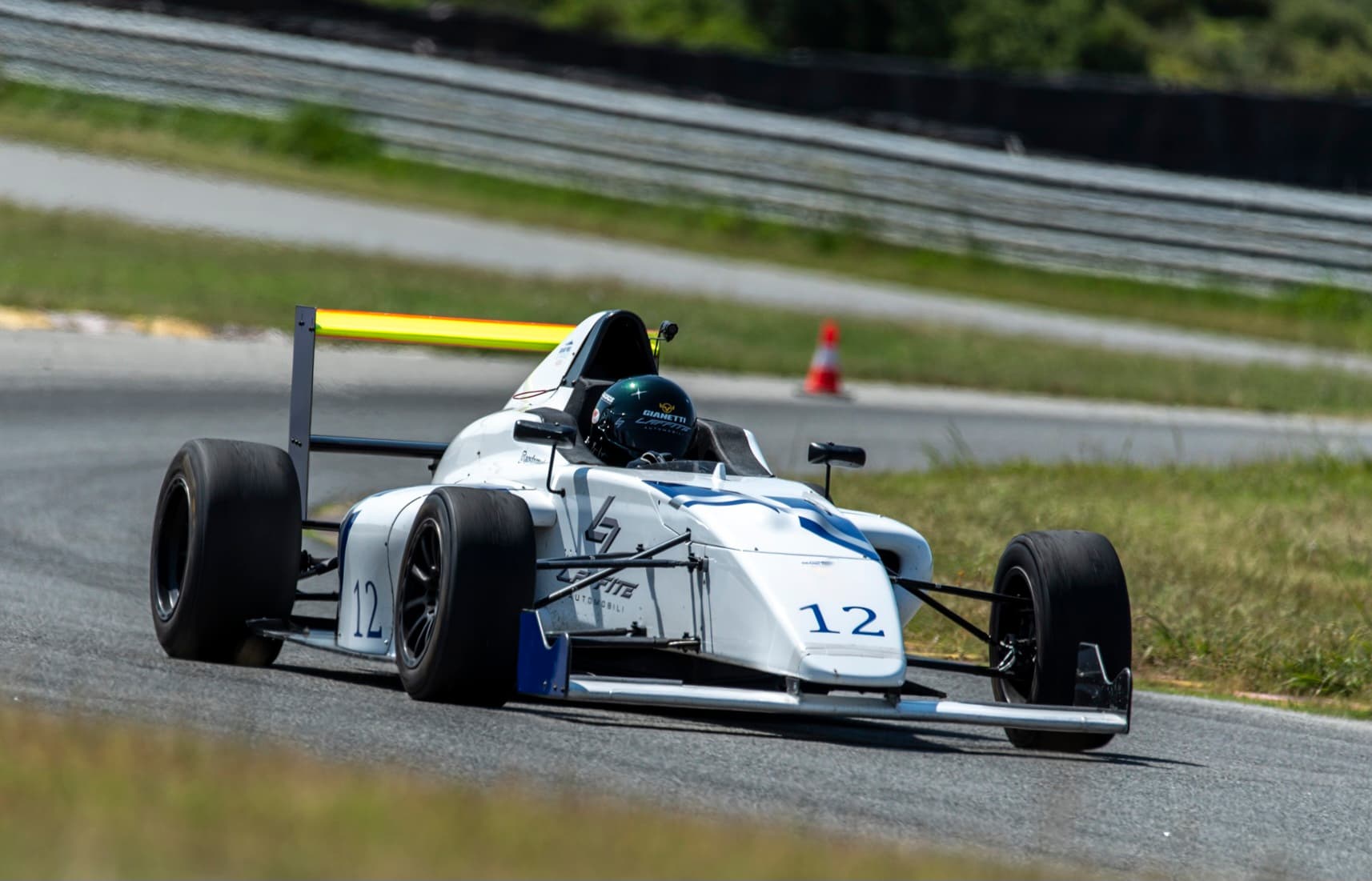
Montlhéry, south of Paris, is not a circuit like any other. The autodrome belongs to the memory of French motor racing, and drivers who start there inherit a heavily furnished stage. In 1990 it still hosted junior grids, among them these Lotus Sevens, light and stripped-back machines in which a driver has nothing to hide behind.
The Seven is an honest car in the hardest sense of the word. Little power, little downforce, no electronics, almost no weight: it does not manufacture performance, it exposes it. Two drivers in two identical Sevens are separated by their driving and nothing else. That is why such grids work as a developing bath, and why a pole on one of them actually means something.
The name, that day, was no help. It was an exposure. Being a Laffite in a French paddock in 1990, four years after Jacques Laffite's last season and his 177 Grands Prix, means starting out in debt. The crowd expects, the rivals watch, and one average session turns into a verdict.
What a pole actually costs
Pole position on a junior grid is not won over one lap. It is won on the ability to understand a track in a few dozen minutes: memorising braking references, feeling grip evolve, knowing that a fresh set of tyres gives its maximum for a lap and a half and no longer. A beginner knows none of this. He learns it while the clock is running.
Then comes the willingness to stake everything on a single attempt. Qualifying is an exercise that punishes prudence: the driver who keeps a safety margin finishes behind the one who keeps none. At twenty, with no personal benchmark and no comparison lap, that decision is taken alone, visor down, on the approach to the fastest corner on the circuit.
“A pole is not simply talent expressing itself. It is a margin you decide not to keep.”
The lap also carries a share of invisible preparation. Fifteen years of competitive tennis, a piano played since the age of six, a childhood spent at the starts of the Rallye Monte-Carlo and the Paris-Dakar beside a father who ran his own small rally team: none of that makes a driver, and all of it contributes. The Montlhéry pole was not improvised. It had been prepared over twenty years, without anyone, the driver included, realising that a preparation was under way.
After the flag
A result like that does not stay private. In the paddock that day stood Jean Todt, then in charge of Peugeot's competition programme. He came to congratulate the newcomer and, in the same breath, offered him a seat in the European Rallycross Championship in a Peugeot 205 T16. A first race, a pole, and a door opening the same afternoon: the sequence is too neat to be common.
What followed confirmed the promise without ever crowning it. Formula Ford, Formule Renault, Formula 3: Bruno Laffite found the budgets, won races, posted front-running results and held his place for ten years among the six best French drivers of his generation. What Montlhéry had announced, he delivered.
What French motor racing owed him, on the other hand, never arrived. The loi Évin, passed on 10 January 1991 and enforced against motorsport from 1993, would drain the funding within a few seasons. None of that is known yet at Montlhéry. There is only a twenty-year-old at the front of the grid, and a lap time nothing had obliged to exist.
Invite Bruno Laffite to tell the behind-the-scenes at your event.